


Outsourcing Class Action Recovery: Four Ways to Run a Recovery Program
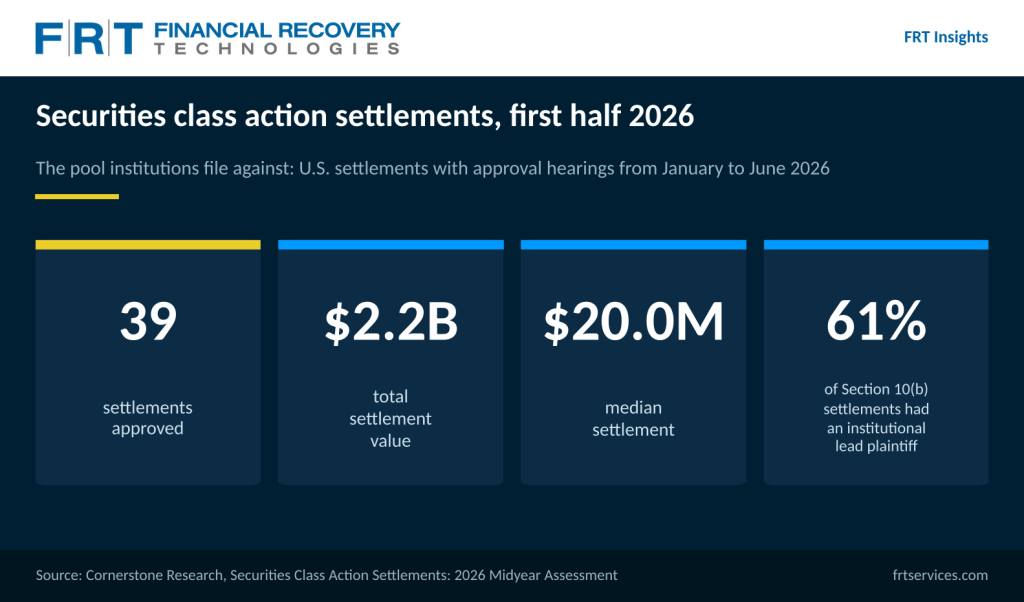
According to Cornerstone Research, securities class actions produced 39 settlements totaling $2.2 billion in the first half of 2026, so institutions weighing outsourcing class action recovery are deciding who collects their share of a large pool. Outsourcing class action recovery means handing some or all of the recovery work (case monitoring, claims filing, deficiency responses and payment reconciliation) to a custodian, a law firm or a specialist provider rather than an in-house team. Financial Recovery Technologies (FRT) compares the four ways institutions run a recovery program below, with the trade-offs of each.
What Is Outsourcing Class Action Recovery?
A class action recovery program has five recurring tasks: monitoring new cases against the portfolio, filing claims when settlements open, answering administrator audits and deficiency notices, reconciling payments against the plan of allocation and deciding whether to take a more active role, such as seeking lead plaintiff status, opting out or joining a non-US action. Outsourcing class action recovery means assigning one or more of those tasks to an outside party under a contract or retainer, while the institution keeps the policy and the final decisions.
The Government Finance Officers Association (GFOA) describes the same choice in its best practice for public pension plans. A plan may use internal staff, negotiate with its custodian bank to perform the work or hire external securities litigation counsel or another third-party claims advisory service. Whoever does it, GFOA recommends periodic reviews to confirm the agreed procedures are being followed.
Why Institutions Outsource Class Action Recovery
Buy or build? It’s an age-old business question that institutional investors continue asking themselves. With more priorities shifting onto operations and legal departments, some of the market’s largest players are using external partners to optimize their recovery programs.
Financial Recovery Technologies (FRT) today powers class action recovery solutions for more than 2,500 global institutions, including three of the top five asset managers and four of the top five asset owners. These institutions have moved recovery work from in-house teams to outsourced programs that free up resources for other strategic initiatives and establish class actions as an area of strength.
In our experience, global asset managers and asset owners are shifting class action recovery onto a trusted third party, with an emphasis on:
- Providing complete coverage across case types
- Improving operational focus
- Mitigating fiduciary risks
- Maximizing recoveries
Four Ways to Run a Class Action Recovery Program
Most institutions use one of four models for class action recovery, or a mix of them: a custodian, a law firm monitoring program, an in-house team or a specialist provider. Each covers different tasks, carries a different cost model and suits a different kind of institution. None is right for every portfolio.
1. Custodian class action services
Many asset owners assign claims filing to their custodian bank, which already holds the trade and position records that claims require. Public pension policies show the pattern. The Orange County Employees Retirement System (OCERS) policy makes its custodial bank responsible for filing all claims in securities class actions where OCERS has losses, with the procedures set out in the custody agreement’s statement of work. The Virginia Retirement System (VRS) policy does the same for U.S. cases. Scope is the main variable: the San Francisco Employees’ Retirement System (SFERS) policy provides for retaining counsel to file claims not covered by the custodian, such as antitrust actions. As of October 29, 2026, several custodians, including State Street and U.S. Bank, deliver their class action services through a specialist partner, FRT.
2. Law firm monitoring programs
Plaintiff securities firms offer portfolio monitoring to institutional investors, usually with no direct fee. The firm receives holdings and trade data from the custodian, matches it against new cases, estimates losses and flags matters where lead plaintiff status, an opt-out or a non-US action may be worth considering. It is paid if it is later retained to litigate, typically on contingency. The Arkansas Public Employees Retirement System (APERS) policy lists “utilizing free securities monitoring services” among its goals and requires its monitoring and litigation firms to work on a contingency fee basis. The model brings merits analysis from lawyers who litigate these cases. Deficiency follow-up and payment reconciliation are not usually the focus of the service, so many plans pair it with a custodian or a specialist. Our explainer on securities litigation monitoring covers how these programs work.
3. In-house class action recovery team
Some institutions run recovery internally, with operations staff handling settlement notices and claims and legal staff deciding on active participation. OCERS, for example, has its Legal Division monitor filings and recommend cases for active participation to its Investment Committee. An in-house program gives full control over data and decisions. It also needs staff time, a reliable feed of settlement notices and trade history that can reach back many years: GFOA recommends keeping trading records for at least ten years. Gaps tend to appear as volumes rise. In one FRT case study, a U.S. hedge fund that managed recovery in-house had missed more than 15 relevant cases with total recognized losses above $50 million. FRT filed late claims in those cases and the fund recovered $1.2 million in its first six months.
4. Specialist class action recovery provider
A specialist provider such as FRT handles the operational side of recovery across case types: monitoring, eligibility analysis, claims filing, deficiency responses, payment reconciliation and analysis of non-US opt-in actions. It does not act as litigation counsel and has no stake in which investor becomes lead plaintiff, so institutions still retain law firms when they take an active role. Providers differ most in what happens after filing. FRT’s April 2026 post, With Third-Party Class Action Recovery, You Get What You Pay For, notes that administrators now send more rejections with shorter deadlines to cure them, and that low-cost providers may accept claim attrition rather than contest it. A specialist is rarely the lowest direct-cost option; the case for one rests on net recoveries and oversight.
Class Action Recovery Models Compared
The table compares the four models on what they cover, where gaps tend to appear, how they are paid for, how they are overseen and which institutions they suit. The interactive comparison below it lets readers weigh the same options against their own priorities.
| Model | What it covers | Typical gaps | Cost model | Oversight and reporting | Best fit |
|---|---|---|---|---|---|
| Custodian | Claims filing in U.S. settled securities class actions, using custody records; scope set in the custody agreement | Antitrust, non-US and other non-standard cases vary by bank; trade history can be lost when custodians change | Negotiated with the custodian bank; terms vary by bank | Periodic filing and recovery reports; some plans, such as OCERS, audit the filing process | Asset owners with one custodian and mostly U.S. holdings |
| Law firm monitoring program | Loss analysis on new filings, alerts on lead plaintiff and opt-out windows, merits advice | Deficiency work and payment reconciliation are not the focus; the adviser may later seek to act as counsel | No direct monitoring fee; contingency fee if retained to litigate | Periodic case and loss reports; plans often retain several firms (OCERS keeps a pool of at least five) | Public pension plans with losses large enough to consider lead plaintiff roles |
| In-house team | Whatever the team staffs: notice intake, claims filing, decisions on active roles | Coverage depends on headcount and data; missed notices and audit backlogs as volumes grow | Salaries, data and systems; no fee on recoveries | Direct control; reporting built internally | Large institutions with dedicated legal and operations staff |
| Specialist provider | Monitoring, claims filing, deficiency responses, payment reconciliation and non-US opt-in analysis across case types | Does not litigate or act as counsel; limited on lowest direct cost | Service fee set by contract; rarely the lowest direct-cost option | Claim-level reporting from notice to payment, often through a client portal | Asset managers, hedge funds, wealth managers and asset owners with global holdings or many accounts |
How Institutions Combine Recovery Models
Many plans use more than one model and give each task to the party best placed to do it. The Sacramento County Employees’ Retirement System (SCERS) policy, amended in October 2025, retains a support services provider for monitoring, claims filing and recovery, then refers any case with recognized damages of $4 million or more to securities litigation counsel for an independent recommendation. VRS has its custodian file U.S. claims, may hand filing to a third-party vendor and retains law firms to advise on cases above its loss threshold.
A combined program needs clear lines: one party owns filing, one owns the decision on active roles and someone reconciles the reports. SFERS staff, for example, compare the custodian’s filing reports with information from monitoring counsel and investigate any differences. A written securities litigation policy is where most institutions set those lines.

Questions to Ask Before Outsourcing Class Action Recovery
- Which case types are covered: U.S. securities, antitrust, SEC Fair Funds, Delaware no-claim-form distributions and non-US actions?
- Who answers administrator audits and deficiency notices, and how are rejected claims challenged?
- How is trade history kept complete when the institution changes custodian?
- How are payments checked against the plan of allocation before a claim is closed?
- Who decides on lead plaintiff, opt-out and non-US participation? Which loss threshold applies?
- What does the board or investment committee receive, and how often?
This page is reviewed every six months and when Cornerstone Research publishes new settlement data or a cited pension policy changes. Next scheduled review: March 31, 2027.
Outsourcing Class Action Recovery FAQ
What does outsourcing class action recovery mean?
It means assigning some or all recovery tasks (monitoring, claims filing, deficiency responses, payment reconciliation and analysis of active cases) to a custodian, a law firm or a specialist provider instead of doing them in-house. Most institutions keep the policy and the final decisions on active participation.
Do custodian banks file class action claims?
Many do for U.S. settled securities class actions, under terms set in the custody agreement. Coverage of other case types varies by bank, which is why policies such as SFERS’s provide for another party to file claims the custodian does not cover.
Is law firm portfolio monitoring free?
There is usually no direct fee. Monitoring firms are typically paid on contingency if they are later retained to litigate, which is why many public pension policies set rules for how monitoring and litigation firms are selected and rotated.
Is outsourcing class action recovery cheaper than running it in-house?
Not always on direct cost. An in-house team avoids service fees but carries staff, data and systems costs and the risk of missed filings. The comparison that matters is net recoveries after all costs, plus the oversight the board needs.
Can an institution combine more than one recovery model?
Yes. Many plans pair a custodian or specialist for filing with law firms for active cases. SCERS, for example, uses a support services provider for monitoring and filing and refers large cases to securities litigation counsel.
Download FRT’s Report on Outsourcing Class Action Services
FRT has published a special report on why institutional firms outsource class action services, which we have made available to prospective clients below. If you are interested in discussing further, please contact our team at learnmore@frtservices.com.