


Template: Building a Shareholder Litigation Governance Policy
Eight public pension policies, including one the Baltimore City Employees’ Retirement System adopted on May 21, 2026, show what a securities litigation policy template should include. A securities litigation policy template should include eleven sections: purpose, roles, monitoring, claims filing, loss thresholds, lead plaintiff criteria, non-US opt-in, opt-outs, counsel selection, reporting and review. Financial Recovery Technologies (FRT) outlines each section with public examples and offers its full template to prospective clients.
Global shareholder recoveries have become more complex in recent years. FRT’s template carried recommended loss thresholds for more than 30 jurisdictions on six continents as of March 2025, and in 2024 Australia, the United Kingdom and the Netherlands accounted for 72% of new non-US filings that FRT tracked. Monitoring these venues and making informed participation decisions remains a challenge, with varying laws and procedures imposing a range of requirements on investors.
As a fiduciary, your funds should be positioned to capture eligible recoveries whenever they are materially harmed by fraud. Yet there’s also a need to allocate internal resources wisely, maximizing recoveries while following sound governance practices that minimize the risk, and the effort, involved.
Addressing these challenges starts with developing standard procedures for managing your shareholder recovery program. To that end, FRT’s team has created a foundational template to help our clients craft a governance policy tailored to their firm’s risk tolerance and corporate objectives.
By establishing a clear recovery program framework, investors can define:
- Appropriate risk and loss thresholds used to steer participation decisions
- Who makes participation decisions for their funds and which factors they will consider
- How decisions are tracked and documented for future reference
What a Securities Litigation Policy Covers: Section-by-Section Outline
A securities litigation policy includes eleven core sections. Public pension plans publish theirs, and the Government Finance Officers Association (GFOA) recommends that every public pension plan adopt one. Read side by side, policies from the Arkansas Public Employees Retirement System (APERS), the Orange County Employees Retirement System (OCERS), the Los Angeles County Employees Retirement Association (LACERA), Colorado PERA (COPERA), the Sacramento County Employees’ Retirement System (SCERS), the San Francisco Employees’ Retirement System (SFERS), the Virginia Retirement System (VRS) and BCERS together cover eleven sections. The outline below lists each one, what it sets out and where to see a public example.
| Policy section | What it sets out | Public examples |
| 1. Purpose and fiduciary basis | Why the institution monitors cases and pursues claims as trust assets; goals such as maximizing net recovery and deterring fraud | APERS Summary and Goals; OCERS Purpose and Principles |
| 2. Roles and delegation | Who monitors, who recommends and who decides; authority to act when a deadline cannot wait for a board meeting | OCERS delegates to its Investment Committee and lets the CEO act when timing requires; SFERS lists duties for board, staff, custodian and counsel |
| 3. Monitoring | Who tracks new U.S. and non-US cases, how losses are estimated and how often reports arrive | OCERS refreshes a pool of at least five monitoring firms every three years, with quarterly reports; SCERS retains a support services provider |
| 4. Claims filing and recovery | Who files proofs of claim, how filing is audited and how payments are reconciled and deposited | VRS and OCERS assign filing to the custodian under a statement of work; GFOA recommends a standing deposit directive |
| 5. Thresholds for active participation | Loss levels that trigger a review for lead plaintiff, opt-out or non-US action; when the plan may go below them | OCERS: $2 million U.S., $250,000 foreign; VRS: three basis points of fund value |
| 6. Lead plaintiff criteria | Factors beyond loss size: merits, other candidates, staff time, discovery burden, trading restrictions | APERS Section IV; OCERS paragraph 13 |
| 7. Non-US opt-in | When to join actions abroad, given funding, adverse costs, discovery burdens and decision rights | OCERS paragraph 14; SFERS $1 million foreign threshold |
| 8. Opt-out and direct actions | When to leave the class and sue individually, with repose deadlines in view | APERS Section III.C; OCERS on CalPERS v. ANZ |
| 9. Counsel selection | How monitoring and litigation counsel are chosen, paid and rotated | APERS and BCERS selection criteria; COPERA retainer signed before selection |
| 10. Reporting | What the board receives and how often: new cases, estimated losses, filings, recoveries | OCERS quarterly reports; SCERS annual recovery report |
| 11. Review cycle | How often the policy is reviewed and who can amend it | APERS Section X; SFERS every three years; SCERS amended Feb. 2024 and Oct. 2025 |
How Public Pension Plans Set Loss Thresholds
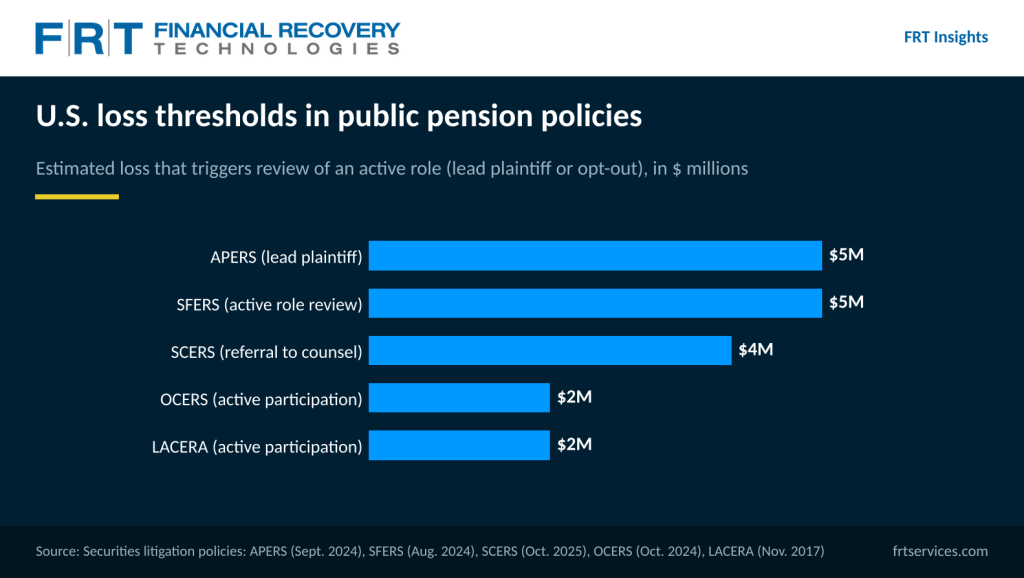
Most policies set a loss threshold that triggers a closer look at a case. Below it, the plan stays in the class and files a claim; above it, staff or counsel evaluate an active role. OCERS reviews U.S. cases at $2 million and foreign cases at $250,000. LACERA uses $2 million, or $1 million when joining other public funds. SFERS evaluates U.S. cases at $5 million and foreign cases at $1 million, SCERS refers cases with $4 million in recognized damages to counsel and APERS requires $5 million before seeking lead plaintiff status.
Other plans scale thresholds to fund size: VRS uses three basis points of total fund value, COPERA two basis points of fiduciary net position and BCERS “two basis points (0.02%), or five hundred thousand dollars ($500,000)” of fiduciary net position for lead plaintiff decisions. Most policies also let the plan go below its threshold for policy reasons, such as joining other institutions or deterring misconduct.
When global recovery opportunities arise, FRT clients receive recommended loss thresholds informed by the participation risks and burdens of a given jurisdiction. While these vary, venues fall into two general categories:
- Passive jurisdictions allow investors to “sit on the sidelines” until a settlement or judgment occurs, at which point they advance their claims in what is largely an administrative process. These include the United States, Canada, Australia and Dutch collective settlements in the Netherlands, among other types of actions.
- Active jurisdictions require investors to participate directly as litigants, and their claims will often be pursued by a group complaint. Major venues include Japan, the United Kingdom and several other European countries.
Our team recommends that investors prioritize “low-hanging fruit” opportunities likely to resolve short of full litigation, as these carry the fewest participation burdens and the highest potential upside. Working with an outside vendor can help your firm identify relevant opportunities and make participation decisions more efficiently.
Monitoring, Claims Filing and Reporting Duties
GFOA’s best practice asks for one designated monitor, written procedures with the custodian for settlement notices and a named party to file proofs of claim. It recommends keeping trading records for at least ten years, sending settlement payments directly to the custodian even when a law firm files and periodically checking large recoveries against the court-approved plan of allocation.
Public policies add audit and reconciliation steps. OCERS staff audit the custodian’s claims filing from time to time and can require changes, and SFERS staff compare the custodian’s filing reports with monitoring counsel’s data and investigate discrepancies. Reporting clauses set the cadence: OCERS reports quarterly to its Investment Committee, with a merits analysis for any matter where its estimated loss exceeds $2 million, while VRS and SCERS report recoveries to their boards each year.

Counsel Selection and Conflict Safeguards
Most policies separate two roles: monitoring counsel tracks cases, while litigation counsel is retained case by case. APERS and BCERS list criteria for choosing litigation counsel, including expertise suited to the claim, willingness to negotiate contingency fees, transparent billing with lodestar records and rotation of interested firms. COPERA requires a written retainer agreement before counsel is selected and contemporaneous time records. SFERS caps contingency fees at 20% unless the circumstances clearly justify more, and generally bars its evaluation counsel from litigating matters it evaluated.
These rules respond to questions courts and researchers have raised about pay-to-play; our explainer on securities litigation monitoring covers that evidence. For institutions deciding who should do the work at all, see outsourcing class action recovery.
This page is reviewed every six months and after any of the eight plans amends its policy. Policy versions and thresholds are as of Oct. 29, 2026. Next scheduled review: April 29, 2027.
Securities Litigation Policy FAQ
What is a securities litigation policy?
A board-approved document that sets out how an institution monitors securities class actions, files claims and decides whether to take an active role, such as seeking lead plaintiff status, opting out or joining a non-US action.
Who should approve a securities litigation policy?
The governing board, or a committee it delegates to, as at OCERS (Investment Committee) and APERS (Investment Finance Subcommittee). Several policies let the chief executive act when a deadline cannot wait, with a report to the board afterward.
What loss threshold do pension funds use for lead plaintiff decisions?
In the public policies reviewed here, U.S. thresholds range from $2 million (OCERS, LACERA) to $5 million (APERS, SFERS). VRS, COPERA and BCERS use basis points of fund value instead.
How often should a securities litigation policy be reviewed?
Few policies fix a cycle; SFERS is an exception and evaluates its policy every three years. Plans revise them as law and practice change. SCERS amended its policy in 2024 and 2025, and OCERS has amended its policy several times since adopting it in 2003, most recently in October 2024.
Is FRT’s securities litigation policy template available to download?
Yes, for prospective clients, through the form on this page. The template includes recommended loss thresholds for more than 30 jurisdictions.