




[Session Recap] 5 Ways the Shareholder Class Action Market Evolved in 2025
From geopolitical uncertainty to rapid advances in AI, macro forces continued to shape global equity markets in 2025.
Against this backdrop, securities class actions remained an essential tool for protecting shareholder interests and recouping losses. As in 2024, FRT once again recovered more than $1 billion for our clients in 2025. With new and potential regulations influencing how investors participate in these cases, staying informed continues to be critical for fiduciaries.
FRT’s in-house legal team recently explored how the shareholder class action landscape has evolved over the past year, as well as what those changes mean for investors moving forward. Continue reading for key takeaways from their discussion, spanning major case types, jurisdictions, and legal mechanisms.
1. Steady 2025 and a Strong Start to 2026
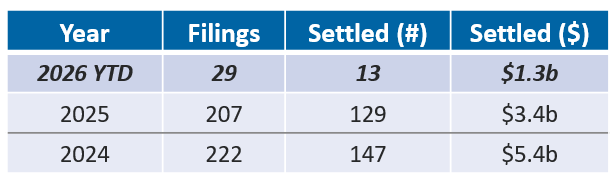
“An average man looks small standing between two NBA players – that’s the story of 2025,” says Mike Lange, SVP Worldwide Litigation at FRT.
In 2024, new class action settlements in the United States and Canada totaled $5.4 billion across 147 cases – both unusually high marks compared to recent yearly averages. In 2025, we saw those numbers fall by 37% and 12%, respectively, year over year, yet they remained within historic norms.
More notably, several large class actions that were nearing court approval last year carried over into January 2026, including a trio of nine-figure settlements: DiDi Global ($740 million), Celgene ($239 million), and PG&E ($100 million). With administration times decreasing to around seven months on average, these cases could pay out to claimants by December, on top of several large 2025 settlements.
The U.S. remains the leading venue for investors to assert their rights when fraud occurs. FRT client recoveries surpassed $1 billion for the second consecutive year in 2025, driven largely by U.S. cases. As the latest numbers illustrate, 2026 is poised to be a standout year for securities class action activity.
2. Greater Focus on Claim Deficiencies
Claims administration – the process of distributing securities class action settlement funds – validates which investors are owed compensation and how much they each receive.
In recent years, the administration firms responsible for handling claim submissions have had to combat an increase in fraudulent claims. At the same time, they face growing pressure from class counsel to process cases more efficiently. These factors have made the deficiency process (i.e., the vetting of filed claims) more challenging and important for investors participating in class actions.
As claim volumes increase, including fraudulent submissions, a few patterns have emerged:
- More claims are being audited, with particular scrutiny placed on high-value claims
- Administrators are demanding more records to substantiate investor trades and holdings
- More claims are being rejected, with only a portion of eligible claimants typically pushing back
In 2025, FRT continued to thoroughly review claim rejections and defend the validity of claims and loss calculations managed by our team. We also piloted creative solutions in these areas where possible. The results have been positive, with our clients receiving around 25% of securities settlements (after legal and administrative fees) on average.
Read more: [Report] Why Securities Class Action Administration Matters
3. SEC Fair Funds in Flux
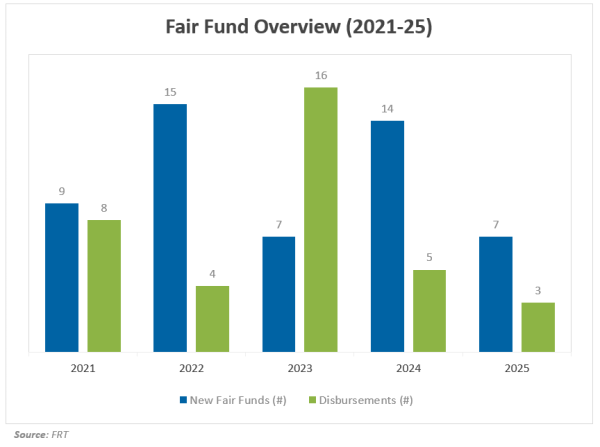
Each year, the SEC resolves enforcement proceedings that result in compensation for harmed investors. A handful of these actions, such as the $200 million Barclays Fair Fund approved last year, involve significant penalties.
Like many federal agencies, however, the SEC experienced staffing reductions in 2025, including at the division overseeing Fair Fund administrations. An extended U.S. federal government shutdown further slowed enforcement activity. In addition, the SEC introduced additional Fair Fund requirements, ranging from case-specific “authorization to file” forms for individual claimants to mandating direct payment to beneficial owners. Combined with the preexisting “100% documentation” requirement, Fair Fund participation has become a major operational burden for investors.
When the number of participating investors decreases, firms whose claims do survive the SEC’s heightened requirements have benefited from higher pro rata payout rates. Our latest data suggests that FRT clients regularly capture roughly 40% of each Fair Fund distribution. As we look toward 2026, FRT will continue to advocate for changes and creative solutions that both enable the agency to meet its goals and make Fair Fund participation more feasible for a wider group of investors.
4. “No Claim Form” Complexity
No Claim Form (NCF) cases are securities class action settlements in which eligible investors receive compensation automatically, without needing to file a claim. While these cases have existed for some time, we have seen more filings and some much higher settlement amounts in recent years, particularly in the Delaware Chancery Court. Though the process is efficient, these cases can create challenges for investment operations teams.
When NCF settlements occur, for example, the assigned administrators will rely on third-party records and send distributions only to the named shareholders of record on the relevant dates. As a result, investors not actively monitoring these cases will receive an unexpected payment – either from a claims administrator, the DTC, or a broker or custodian under which the shares were first purchased. Categorizing these NCF payments, and further allocating them across accounts or client funds, only adds to the complexity.
FRT tracked a steady stream of NCF distributions last year. In fact, the two largest such cases – Santander ($162.5 million) and Viacom ($122.5 million) – were among the top 10 class actions to pay out in 2025. Our team continues to support these atypical recoveries, providing notifications to clients at critical stages of the case lifecycle that simplify payment verification and allocation.
Read more: No Claim Form, No Problem: Managing Atypical Class Action Distributions
5. A Banner Year for Australian Class Actions
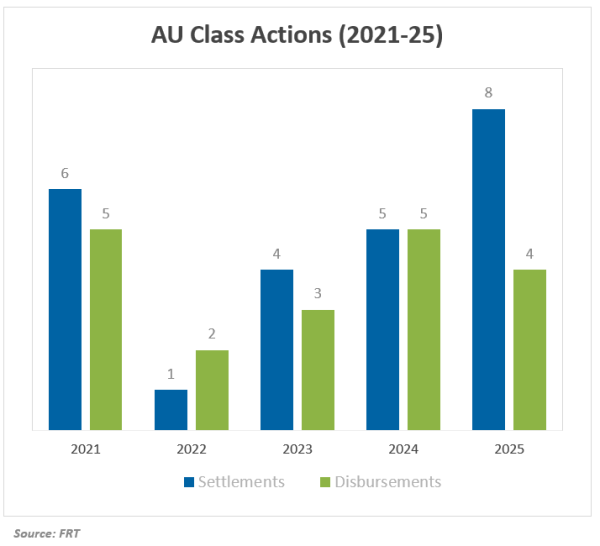
Most global jurisdictions fall into one of two categories for shareholder recovery: passive and active. In active jurisdictions, such as the United Kingdom, investors must opt into group litigation directly. Passive jurisdictions allow investors to “sit on the sidelines” until a settlement or judgment occurs – after which point they can either advance their claims or choose to opt out of the group.
Besides the U.S., Australia is perhaps the best example of an efficient passive jurisdiction, as it features a class action system with no participation risks for investors. Last year, eight Australian class actions settled while four disbursed to investors. More importantly, the settlement sizes have grown, with cases involving BHP Billiton ($100 million), Crown Resorts ($72.5 million), and Treasury Wine Estates ($65 million) headlining 2025 activity. Recovery percentages for these cases are also greater than what we typically observe in U.S. or opt-in cases, with investors capturing 38% of their losses on average.
FRT takes a distinct approach to registering clients for Australian cases – one that streamlines the process for our clients. As a result, we have seen an increase in registrations and a corresponding increase in settlement amounts. Australia should remain a strong venue for recoveries in 2026.
Watch the Full Session Recording
The takeaways above only scratch the surface of what FRT shared with live attendees. Complete the form on this page to request the on-demand recording, which includes more detailed insights such as:
- How recent U.S. investor rights policy changes could affect class actions
- The 2026 outlook and pipeline for SEC Fair Funds
- Analysis of the global opt-in landscape and securities-related antitrust cases
- The most significant new settlements and disbursements of 2025