




SEC Fair Fund Claims: Strategies for Solving 3 Key Recovery Challenges
As of November, 2026, the SEC has ordered first payouts on SEC Fair Fund claims in 16 Fair Funds from its administrative proceedings this year, totaling about $552 million and coming a median of 21 months after each plan was approved. The main challenges of filing SEC Fair Fund claims are documentation, deadlines and remittance: plans require third-party records for every trade, give claimants little time to fix errors and pay the beneficial owner directly. Financial Recovery Technologies (FRT) explains each challenge and how institutions can address it.
SEC Fair Funds resemble standard securities class action settlements, but their goals and the parties involved differ. Most notably for investors, Fair Funds have specialized requirements that can make participation more difficult.
As a regulatory agency, the U.S. Securities and Exchange Commission is chiefly focused on regulation and deterrence rather than investor compensation. To participate in Fair Funds, investors must “play by the rules” and conform to the SEC’s standards and processes.
If these hurdles are cleared, however, Fair Fund recovery opportunities can be significant. FRT’s research counts 51 SEC-approved Fair Funds totaling $3.5 billion from 2021 to 2025, including the $200 million Barclays Fair Fund approved in 2025. In 2024 alone, FRT tracked 10 new Fair Funds worth more than $530 million.
The difference between a successful recovery and a rejection frequently boils down to the small details. With that in mind, here are the most common recovery challenges FRT sees with Fair Funds and our team’s best practices for addressing them.
Challenge #1: Documentation Requirements
The strongest barrier to investor participation in Fair Funds is the SEC’s requirement for third-party trade substantiation records. The agency ideally wants to see 100% documentation for every holding and trade, proven by custodial and brokerage records created at the time of the activity.
These requirements make Fair Fund participation especially difficult for older claim periods, when records are difficult to retrieve or no longer exist because the time required for preservation has passed. The $152 million Weatherford International Fair Fund is an example: its plan, approved in May 2024, covers purchases from Feb. 25, 2009 to Nov. 12, 2012.
Claim administrators also have not taken a uniform approach to these requirements. More recently, however, we’ve seen more audit requests from the SEC and more strict enforcement by administrators. FRT discussed these Fair Fund challenges in its 2024 mid-year Market Insider session. Through Dec. 3, 2024, FRT’s recovery data showed Fair Fund audits up 125% year over year. FRT has seen the trend continue into 2026.
Our Approach: Alternative Documentation
When permitted, FRT has used affidavits from clients testifying to the reliability of system records either from third-party sources (e.g., custodians and prime brokers) or even the reliability of a client’s own systems. This approach is often necessary when third-party records have not been preserved over time or are otherwise difficult to obtain.
Approved plans now spell out these rules. The Barclays Fair Fund plan, for example, requires third-party filers to submit the beneficial owner’s name and tax ID with broker statements or confirmations for every purchase, sale and holding. It also states that rejection for insufficient documentation is final and within the administrator’s discretion.
Challenge #2: Faster Administration
Compared to securities class actions, Fair Fund administrations have tighter turnaround times and more rigorous compliance demands. For example, deadlines for responding to SEC document requests are more strictly enforced, and investors have less room for error when the documents do not exactly match data submitted on the claim form.
And while it’s not uncommon for courts to permit exceptions that expand participation in class action settlements – such as accepting claims filed late if distributions have not yet occurred – the SEC does not give investors an opportunity to “save” their claims by substantiating other holdings and trades. Instead, all claims are effectively rejected.
Our Approach: Proactive Communication
As a best practice, FRT routinely works with claim administrators to understand the types of records accepted for a Fair Fund submission to maximize our clients’ lead times for document retrieval. In some cases, this also allows firm to better assess whether the time required to gather the required records outweighs the potential recovery opportunity.
Persistent and proactive communication with Fair Fund administrators has enabled FRT to streamline document retrieval and optimize claim submission for clients.
And while it’s not uncommon for courts to permit exceptions that expand participation in class action settlements (such as accepting claims filed late if distributions have not yet occurred), the SEC does not give investors an opportunity to “save” their claims by substantiating other holdings and trades. Instead, all claims are effectively rejected.
As a best practice, FRT routinely works with claim administrators to understand the types of records accepted for a Fair Fund submission to maximize our clients’ lead times for document retrieval. In some cases, this also allows firms to better assess whether the time required to gather the required records outweighs the potential recovery opportunity.
Persistent and proactive communication with Fair Fund administrators has enabled FRT to speed up document retrieval and optimize claim submission for clients.
Challenge #3: Remittance
The SEC requires that the full Fair Fund payout be distributed to the beneficial owners, without subtracting any contingent fees. This creates an operational hurdle for investors that work with a third-party filer and normally elect to pay a contingent fee out of the total pool of funds recovered from a given settlement. Recent plans make the rule explicit. The Barclays plan states that a Third-Party Filer shall not be the payee of any Distribution Payment and that its compensation may not be paid or deducted from the payment.
The SEC requires that 100% of Fair Fund payouts be distributed to the beneficial owners, without subtracting any contingent fees. This creates an operational hurdle for investors that work with a third-party filer and normally elect to pay a contingent fee out of the total pool of funds recovered from a given settlement.
As a result, some third-party filers have either started requiring upfront payment from clients or stopped servicing Fair Funds altogether.
Our Approach: Adaptive Processes
FRT has adapted its internal workflows to minimize any disruptions the SEC’s evolving requirements have on our clients. This includes establishing remittance processes that comply with SEC requirements, in ways that can be audited if needed, while still allowing our team to service clients within their existing agreements.
Why SEC Fair Fund Claims Are Rejected and How Deficiencies Are Cured
Rejection rates can be high. FRT reported that 95% of submitted claims were denied in the Mylan Fair Fund. Most approved plans follow the same review sequence, set out in the Barclays plan as an example. The Fund Administrator sends a Claim Status Notice to each deficient claimant, there within 150 days of the Claims Bar Date, explaining what is missing. The claimant then has 30 days to cure the deficiency or request reconsideration, with supporting documents. A Determination Notice follows with the final eligibility ruling and Recognized Loss. The claimant then has 30 days to dispute the loss calculation.
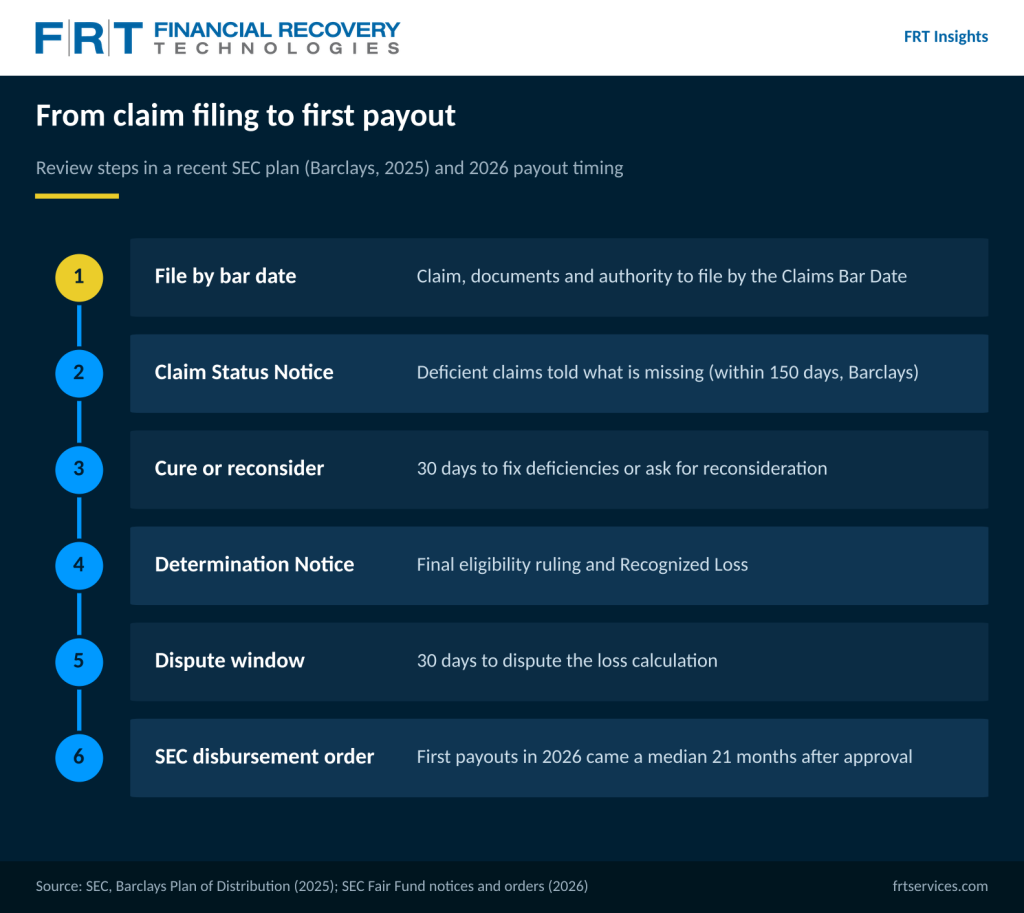
Common causes of rejection FRT sees include broker records that do not match the trades on the claim file, missing beneficial owner tax IDs, a missing master proof of claim or authority to file and trades in excluded instruments such as options or swaps. Claims below the plan’s minimum payment ($25 per security in the Barclays plan and $10 in the Weatherford plan) receive nothing. Their share is reallocated to other claimants.
How Long SEC Fair Fund Claims Take to Pay Out
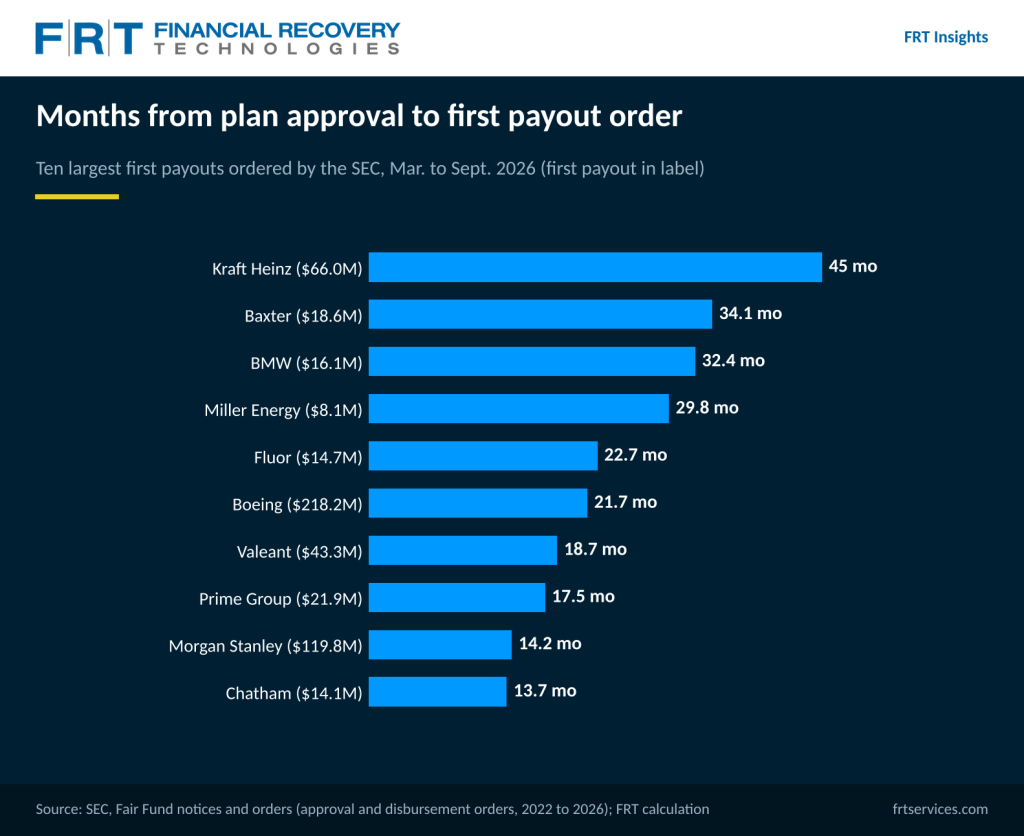
Fair Fund payouts take time even after a plan is approved. Of the 16 Fair Funds in SEC administrative proceedings that received an SEC order directing a first disbursement between March and September 2026, the median interval from plan approval to that order was about 21 months. The range ran from 11 months (Pinnacle Investments) to 45 months (Kraft Heinz). The two largest first payouts, $218.2 million from the Boeing Fair Fund and $119.8 million from the Morgan Stanley Fair Fund, came about 22 and 14 months after plan approval. Operations teams can use those intervals to plan for remittance, since payments now often arrive by check or direct deposit to the account holder.
Timing is also under official review. In its spring 2026 report to Congress, the SEC’s Office of Inspector General wrote:
“We have initiated an evaluation to determine whether the Division of Enforcement has processes and procedures that ensure timely, efficient, and effective collections of delinquent disgorgements and penalties and disbursements of funds to harmed investors.”
SEC Office of Inspector General, Semiannual Report to Congress, October 1, 2025 to March 31, 2026, U.S. Securities and Exchange Commission, Office of Inspector General. SEC OIG Semiannual Report to Congress (Inspector General Kevin B. Muhlendorf), May 2026
The OIG said the review covers collections and distributions data from FY 2021 through FY 2025.
That’s why post-claim submission support has become a critical area where third-party filers can deliver value. FRT is no stranger to challenging administrative decisions when we feel the penalties for document audit failures are too broad, because we understand that harmed investors aren’t paid out unless they survive “the full gauntlet.”
SEC Fair Fund Claims Checklist for Operations Teams
Before the Claims Bar Date, operations teams can check the following against the approved plan:
- Read the plan’s documentation clause for the records each claim needs (broker statements, confirmations, holdings on key dates).
- Request historical custodian and prime broker records early, especially for relevant periods more than five years old.
- Confirm the beneficial owner’s legal name, tax ID and contact details for every account.
- Use the administrator’s electronic filing template and file the master proof of claim and authority to file with the data.
- Calendar the 30-day cure and dispute windows that follow each Claim Status Notice and Determination Notice.
- Agree in advance how direct payments to account holders will be tracked and reconciled.
The Key Difference-Maker? Support
In the U.S., many securities class action settlements are routine, to the point that FRT can automate much of the recovery process for our clients. But Fair Funds have become a major exception. We have increasingly seen faster distributions with stricter requirements that tend to exclude more claims than they include.
For the Fair Fund that brought several of these requirements together, see FRT’s Barclays Fair Fund case spotlight. For how Fair Funds differ from class action settlements, see SEC Fair Funds vs securities class actions.
SEC Fair Fund Claims FAQ
Do SEC Fair Fund claims need third-party documentation?
Yes. Most SEC Fair Fund plans require broker or custodian records for every claimed purchase, sale and holding, submitted with the claim by the Claims Bar Date. Some administrators accept affidavits when third-party records no longer exist.
Can a rejected SEC Fair Fund claim be fixed?
Often, if the claimant acts quickly. Under typical plans, a deficient SEC Fair Fund claim can be cured (or reconsideration requested) within 30 days of the Claim Status Notice. After the Determination Notice, only the loss calculation can be disputed.
Can a third-party filer deduct its fee from an SEC Fair Fund payment?
No. Recent SEC Fair Fund plans, including Barclays, require payment to the beneficial owner and bar third-party filers from being the payee or deducting fees from the payment.
How long does an SEC Fair Fund take to pay claims?
SEC Fair Fund payouts commonly take more than a year after plan approval. For the 16 Fair Funds in SEC administrative proceedings with first disbursement orders from March to September 2026, the median gap from plan approval was about 21 months.
FRT will never sell, share, or rent your email.