


Litigation Funding in Securities Class Actions: The Devil Is in the Details
Litigation funding in securities class actions came under closer court control in 2026, when the Federal Court of Australia fixed a funder’s commission at 25%, below the 30% it sought. The funding is a contract: a third-party funder pays the legal costs of a shareholder claim in return for a share of any recovery. The agreement’s payment waterfall, and whether a court reviews it, decides how much of a settlement reaches investors.
Recovery efforts in some countries outside the U.S. have proven challenging, with some of the successes there smaller than expected. Whether clients see much from these recoveries frequently depends on the terms of the organizer’s funding agreements and, more specifically, the amount of expenses reimbursed before funds are distributed to group members.
Registration documents, including funding agreements, can be dense and complex, sometimes exceeding 150 pages of legalese. They’re drafted by case organizers (lawyers and funders) trying to both protect and maximize returns on their investments of time and capital. Having read hundreds of these agreements, we appreciate that the devil is often in the details.
Here we offer some general observations, particularly on the importance of funding agreement “waterfalls” (terms specifying the priority of payments from recoveries) and how prosecution costs and the types of expenses reimbursed can affect both the percentage share and absolute amounts from recoveries received by claimants. We offer these comments not to discourage client participation, which we fully support, but to ensure clients join with fully informed expectations.
How litigation funding works in securities class actions
Most U.S. securities class actions run on contingency. Plaintiff firms advance the costs and the court awards their fees from the settlement, so investors who stay in the class rarely sign a funding agreement. Outside the U.S. the model is different. In opt-in group claims in the UK and Germany, investors join as named parties and a third-party litigation funder pays legal fees, experts and often insurance premiums. In return the funder takes a share of any recovery. Third-party litigation funding is non-recourse: if the claim fails, the funder loses its capital. The agreement investors sign at registration sets the funder’s fee, the order of payments from any recovery, who controls settlement and who carries the risk of paying the defendant’s costs.
The Fundamentals of Funding Agreements
Clients should understand the basics of funding agreements and their potential impact on future resolutions and clients’ bottom lines. Most important is the difference between gross and net recoveries.
- Gross recovery is the full consideration paid by defendants after settlement or judgement.
- Net recovery is the gross recovery less case expenses taken ‘off the top,’ plus any other priority payments made to case organizers before the remaining balance is shared among the claimant group.
If prosecution costs are high, the variance between gross and net recovery can be substantial, resulting in a larger share of recoveries to case organizers than is suggested by the percentage success fees in litigation funding agreements. We encourage clients to model potential outcomes, particularly for small recoveries in countries where the gross/net variance may be significant due to high prosecution costs.
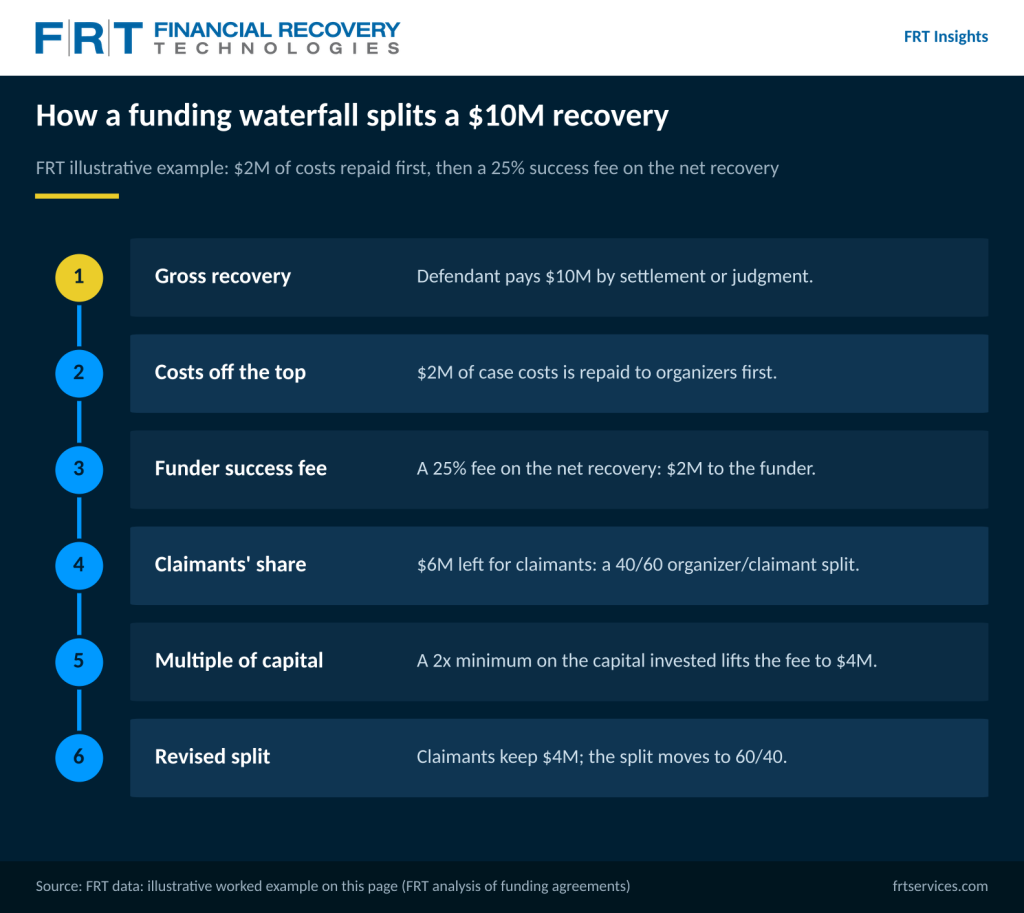
Case organizers front-load returns on their investments. Under the waterfall provisions in funding agreements, they are paid first and in doing so, recover more when recoveries are small and expenses are high. For example, if the gross recovery is $10M, and there are $2 million in costs along with a 25% success fee to the funder, then the net amount to claimants is $6M. ($10M minus $2M minus 25% of $8M).[1] This results in a 40/60 split between case organizers and claimants. If, however, prosecution costs are twice as much – $4M instead of $2M – case organizers receive $5.5M while claimants get $4.5M, a 55/45 split. In other words, most of the recovery goes to the organizers.
Organizers would likely argue it’s unfair to lump together expense reimbursement and commissions when considering recovery splits. However, not all expenses involve cash outlays to third parties. Many represent returns on the organizers’ time and capital paid as cases progress. For example, costs for investigations, book building, and pre-filing settlement attempts are paid from litigation budgets. Counsel gets a substantial portion (e.g., 75%) of their hourly rates as suits proceed. Funders often charge fees for managing litigation and instructing counsel. They may earn interest on invested capital.
Funders may also capture a larger share of recoveries if their success fees are multiples of invested capital. For example, funders may receive 2-3x their invested capital upon success. This may be their sole compensation method, or it may establish a floor on the percentage success fees. When settlements are small, the multiple on invested capital approach can consume far more of the recovery than suggested by a straight percentage commission rate. In the first example, if the funder invested the $2M in costs and the funding agreement specified success fees equal to the greater of 25% or 2x invested capital, the funder’s fee would be $4M rather than $2M and the organizer/claimant split would be 60/40 rather than 40/60.
Understanding Funder Incentives
Across cases we’ve seen many variations, some better and some worse for claimants. However, there is always one constant. Funders have dual incentives: they want to protect their invested capital and earn a return on it, and they want to settle for the greatest amount they can (entitling them to a higher amount in success fees). When cases are strong, there is limited tension between the two. But when recovery prospects decline – e.g., due to weakening case merits or collectability issues – organizers may have different incentives. They may prefer settling for lesser amounts to ensure they recoup their investment and earn a small return, rather than continue investing more capital if the chances for a better outcome have diminished.
In all cases, the organizers’ capital bet is hedged. In most cases, they will get their principal back, since every case has some settlement value even if it’s only nuisance, namely the amounts companies anticipate having to spend on defense that they would prefer to pay earlier to avoid those costs and buy peace.
Since expenses are paid first, ‘off the top’ of any recovery, their investment is reasonably secured. Certainly more so than their success fees, which are contingent on the success of the case, much as bondholders bear less risk than equity holders when company fortunes decline. The tension between capital protection and the prospects for success fees is greatest in countries where prosecution costs are high, like the U.K. and more recently Germany, as the organizers have more invested capital to protect.
The combined assurance of case costs getting paid first, and the receipt of some compensation as cases proceed, means organizers have more incentive to organize and pursue matters than they would if their returns were wholly based on success and pari-passu (on equal footing) with returns to investors. They also have greater incentive to settle for smaller amounts when the prospects for success diminish.
The degree to which organizers control resolutions varies by country and matter. However, funding agreements always allow them to stop further investment if recovery prospects diminish to the point where they determine the case is no longer viable; and they often partially or fully control the settlement process, including approval. So, in practice, claimants are beholden to the funders’ incentives and choices.
Adverse costs and ATE insurance in opt-in decisions
A funding agreement covers the claimants’ own costs. Adverse costs are a separate risk in opt-in claims. Under the English “loser pays” rule, a claimant group that loses can be ordered to pay the defendant’s reasonable legal costs, and group members usually share that exposure pro rata by estimated loss. Funders manage the risk with after-the-event (ATE) insurance, which pays the defendant’s costs if the claim fails. In June 2025 the Civil Justice Council’s final report recommended that ATE insurance with anti-avoidance endorsements be in place whenever funding supports group or collective proceedings.
The same report recommended codifying the courts’ case-by-case approach to a funder’s own liability for adverse costs, in place of a fixed cap tied to the funder’s investment. Courts outside England already treat ATE cover as real protection: in iProsperity v Crown Melbourne [2025] NSWSC 1525, the Supreme Court of New South Wales accepted an ATE policy as security for costs of $2 million. Before joining an opt-in claim, investors can ask:
- Who pays adverse costs if the opt-in claim fails? Is each claimant’s share of adverse costs capped?
- How large is the ATE insurance policy? Does it carry an anti-avoidance endorsement?
- Is the ATE premium deferred and paid from recoveries? If so, it sits in the waterfall ahead of claimants.
- Will the claimant’s identity be disclosed to the court or the defendant?
PACCAR and UK litigation funding agreements: where things stand
On July 26, 2023, the UK Supreme Court held in PACCAR that litigation funding agreements (LFAs) paying funders a percentage of any recovery are damages-based agreements (DBAs) under section 58AA of the Courts and Legal Services Act 1990. DBAs must meet specific regulatory requirements, so many existing LFAs in UK group claims became open to challenge. DBA requirements fall into three groups:
- Subject matter: DBAs are not permitted in Competition Appeal Tribunal (CAT) opt-out collective proceedings. The restriction does not apply to opt-in group securities claims.
- Maximum fees: payments under a DBA are capped at 50% of the sums ultimately recovered, including VAT. Most securities LFAs fall below this level, but a minimum return set as a multiple of invested capital can exceed it when recoveries are small.
- Justification: a DBA must state the reasons for its percentage fee.
For opt-in securities claims, Financial Recovery Technologies (FRT) expected the effect to be modest. Funders could review existing agreements and amend terms where needed, and new agreements would be drafted to comply with DBA rules. FRT also expected some funders to finance law firms, which would then contract with claimants. The reviews slowed some pending actions and the filing of new ones. They also added uncertainty for investors already weighing adverse costs and reliance evidence. Unlike CAT collective proceedings, UK opt-in claims have no court review of funding terms before the case proceeds. An LFA is usually examined only if a dispute arises after recovery.
The Litigation Funding Agreements (Enforceability) Bill, introduced in the House of Lords in March 2024, would have reversed PACCAR with retrospective effect. It fell before enactment when the parliamentary session ended ahead of the July 2024 general election. Since then:
- June 2, 2025: the Civil Justice Council’s final report made 58 recommendations. They include legislation to reverse PACCAR with prospective and retrospective effect, light-touch statutory regulation of funders and court approval of funder returns in collective proceedings. The report rejected caps on funder returns.
- December 17, 2025: the Ministry of Justice said it would legislate, when parliamentary time allows, to make clear that LFAs are not DBAs and to regulate them. The minister’s written statement said the change would have prospective effect.
- May 13, 2026: the King’s Speech did not include a PACCAR bill.
- September 3, 2026: justice minister Lord Lemos told the House of Lords the government was still looking for a legislative vehicle and gave no timetable.
Asked about timing in a September 3, 2026 Lords debate, justice minister Lord Lemos said:
“We are working urgently to identify a new legislative vehicle to take this forward.”
Lord Lemos, Parliamentary Under-Secretary of State, Ministry of Justice, UK Ministry of Justice. House of Lords Hansard, debate on opt-out collective court actions and litigation funding, Sep 2026
He gave no date for a bill.
Until Parliament acts, PACCAR remains law and new UK funding agreements are drafted on that basis. The government has said the reversal will have prospective effect, so older LFAs in pending group claims are likely to keep their DBA risk. Investors in those claims can ask organizers whether their agreement has been reviewed against DBA rules. 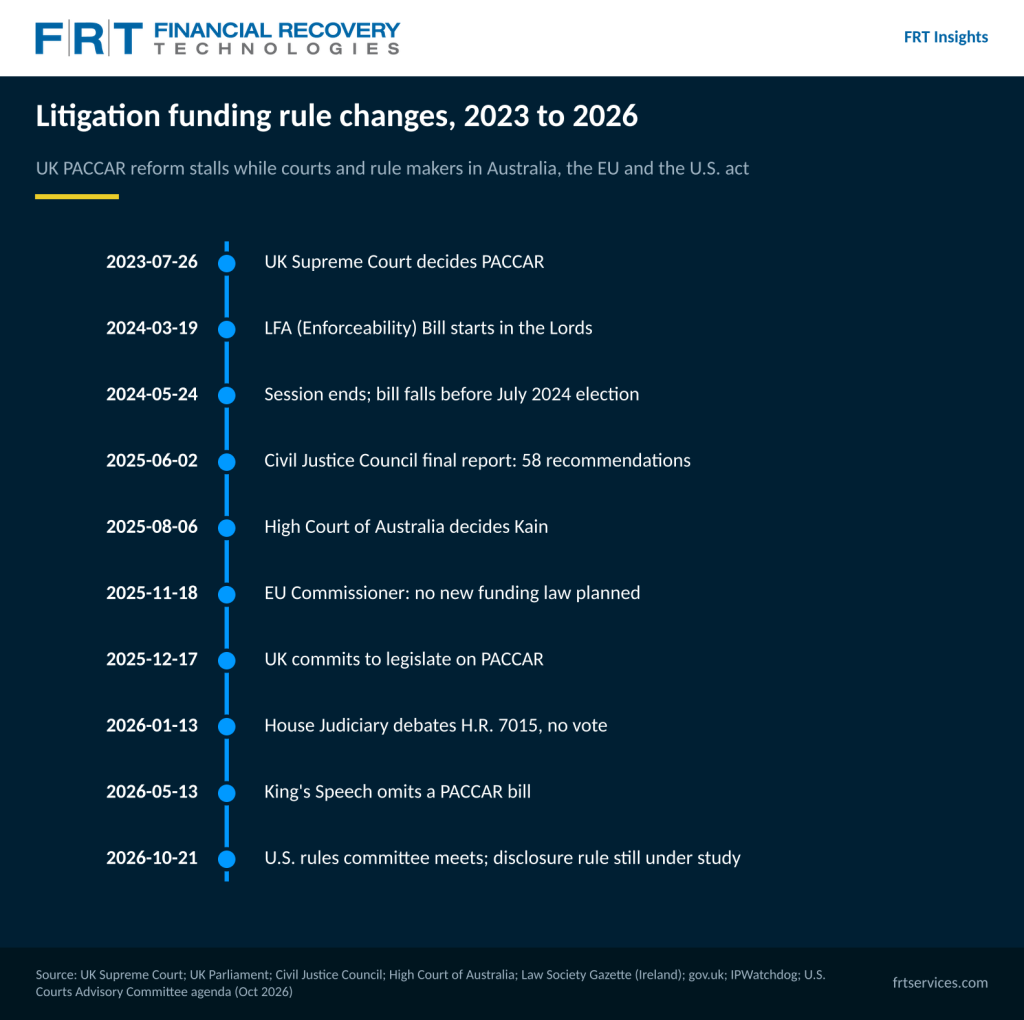
Litigation funding rules in the EU and the Netherlands
The EU has no funding-specific law. The Representative Actions Directive requires member states to prevent conflicts of interest when a third party funds a representative action, including funding by a competitor of the defendant. In November 2025, the Law Society of Ireland Gazette reported that EU Justice Commissioner Michael McGrath said the Commission does not plan new legislation on third-party litigation funding and will focus on how the directive is applied.
The Netherlands applies its own controls on litigation funding. Under the WAMCA (Article 3:305a of the Dutch Civil Code), a claim organisation must show it has enough funds and keeps control of the case. The court reviews the funding on its own motion before the claim proceeds and can require the funding agreement to be filed. Dutch courts have cited roughly 10% to 25% of damages as an acceptable funder fee. In December 2025 the Hague Court of Appeal found that a claim organisation in an investor claim against Airbus lacked independence because commercial co-funders shared in proceeds and effectively drove the case. That review gives investors in Dutch claims a check on funder terms that UK opt-in claimants do not have.
Australia: courts set litigation funder commissions
In Australia, courts control funder returns directly. On August 6, 2025, the High Court held in Kain v R&B Investments [2025] HCA 28 that the Federal Court can make common fund orders paying a litigation funder from a settlement or judgment. It cannot make similar orders for solicitors where contingency fees are prohibited, which leaves the Supreme Court of Victoria and its group costs orders as the exception. Courts then fix the rate. In Excel Texel v Wilson (No 2) [2026] FCA 154, the Federal Court set a funder’s commission at 25%, below the 30% it sought, after noting market rates of 20% to 35%. Australian class actions are opt-out, so registered group members carry fee risk rather than cost risk. Recent Australian cases have returned about 38% of investor losses on average, according to FRT data.
U.S. disclosure rules for third-party litigation funding
No federal statute or nationwide rule requires parties to disclose litigation funding in U.S. civil cases. The District of New Jersey has required it since June 21, 2021. Under Local Civil Rule 7.1.1, each party must identify any non-recourse funder, state whether the funder’s approval is needed for litigation or settlement decisions and describe the funder’s financial interest. A September 2026 Federal Judicial Center study found positive disclosures in 104 cases over five years. The federal Advisory Committee on Civil Rules formed a funding subcommittee in October 2024. In its report for the committee’s October 21, 2026 meeting, the subcommittee said it was still considering a disclosure rule under Rule 26(a)(1), Rule 16 or Rule 7.1.
As of the Advisory Committee’s October 2026 agenda, Congress had at least five funding bills pending. They include the Protecting Third Party Litigation Funding From Abuse Act (H.R. 7015), which, IPWatchdog reported, the House Judiciary Committee debated in January 2026 without a vote; the Litigation Funding Transparency Act of 2026 (S. 3826); and the Tackling Predatory Litigation Funding Act (S. 1821). Bloomberg Law reported that S. 1821 would tax funder profits and that a version of the tax was removed from the 2025 reconciliation bill by the Senate parliamentarian. States are moving faster. Ohio adopted funding regulation in 2026 and North Carolina banned outside litigation investment in June 2026, according to the Advisory Committee’s October 2026 agenda.
For institutional investors that stay in U.S. securities class actions, the direct effect is limited, since plaintiff firms fund most of these cases on contingency. Disclosure rules could matter more for investors that pursue funded direct actions, where the funding statement becomes part of the court record.
Key Takeaways for Investors
For investors, there are multiple main points to bear in mind. Capable providers with experience reading funding agreements can assist you in understanding the devilish details in specific registration documents and funding agreements.
- Consider country prosecution costs: When modeling recovery outcomes for countries with high prosecution costs, increase the percentage you assume will go to cost reimbursement. In other words, assume a substantial variance between gross and net recoveries.
- Consider past recoveries: The track record for recoveries in countries may be limited or vary greatly by matter. Model an average recovery rate (e.g., 20% of estimated losses) and a small recovery rate (e.g., 5% to 10%), particularly if there is a history of modest outcomes in that jurisdiction.
- Consider group size: After expense reimbursements and priority payments, the remaining amounts typically get divided pro rata among group members based on their estimated losses at the start of suit. What claimants get back in absolute dollars depends both on the net recovery amount and how widely it must be spread. A $10M net recovery goes three times further if there are $100M in group losses than if they are $300M.
- Set appropriate loss thresholds: Consider adjusting your minimum loss thresholds per country to ensure absolute dollar amounts are meaningful even in small recovery situations, particularly if there’s a history of them there. Countries with high prosecution costs are often the same as those that impose significant participation burdens on claimants. We’ve found that nothing is more frustrating for clients than doing a lot of work to get little or nothing in the end.
- Check adverse cost cover in the funding agreement: Confirm who bears the defendant’s costs if the claim fails, how large the ATE policy is and whether its premium is paid from recoveries.
- Know which regime sets the funder’s return: Funder returns are set by contract in UK opt-in claims, reviewed by the court in Dutch WAMCA claims and fixed by the court in Australian settlements. Check which applies before you register.
Litigation funding FAQ
What is third-party litigation funding?
Third-party litigation funding is non-recourse finance from an investor that is not a party to the case. The funder pays legal fees and other costs in return for a share of any recovery and loses its capital if the claim fails. In shareholder claims outside the U.S., funders typically back opt-in group actions in jurisdictions such as the UK and Germany.
How much do litigation funders take from a class action recovery?
It depends on the agreement and the court. Dutch courts have cited about 10% to 25% of damages as acceptable. An Australian court observed market commissions of 20% to 35% and set 25% in a 2026 case. UK opt-in agreements are not court-approved, so the waterfall terms decide the split. Costs repaid first can push the organizers’ share well above the headline fee, as the worked example above shows.
Is litigation funding still enforceable in the UK after PACCAR?
Agreements that pay a funder a percentage of recovery must comply with DBA rules until Parliament acts. The government committed in December 2025 to legislate, but as of October 29, 2026 no bill had been introduced.
Do investors pay adverse costs in UK opt-in claims?
They can. The losing side usually pays the winner’s reasonable costs, and group members typically share that exposure pro rata by loss. ATE insurance and funder indemnities are the usual protection, so their terms are worth reviewing before registration.
Do U.S. courts require disclosure of litigation funding?
Some do. The District of New Jersey requires it under Local Civil Rule 7.1.1, and some judges require it by standing order. The Advisory Committee on Civil Rules is studying a nationwide rule, and several bills in Congress would mandate disclosure.
More Global Recovery Insights
FRT has compiled an industry-leading resource library for institutional investors, featuring securities litigators and other industry experts discussing global recovery opportunities in active and passive jurisdictions.
Access our resource library below for in-depth intel on funding agreements, adverse cost risks, after-the-event insurance, and more:
[1] In some cases, funder success fees may be a percentage of gross rather than net recoveries, further increasing organizer shares.